Do you get wet on the Niagara boat ride?
The poncho is a gesture, not a solution.
 Written with Michael Thompson, Niagara Falls boat tour specialist and local guide
Short answer
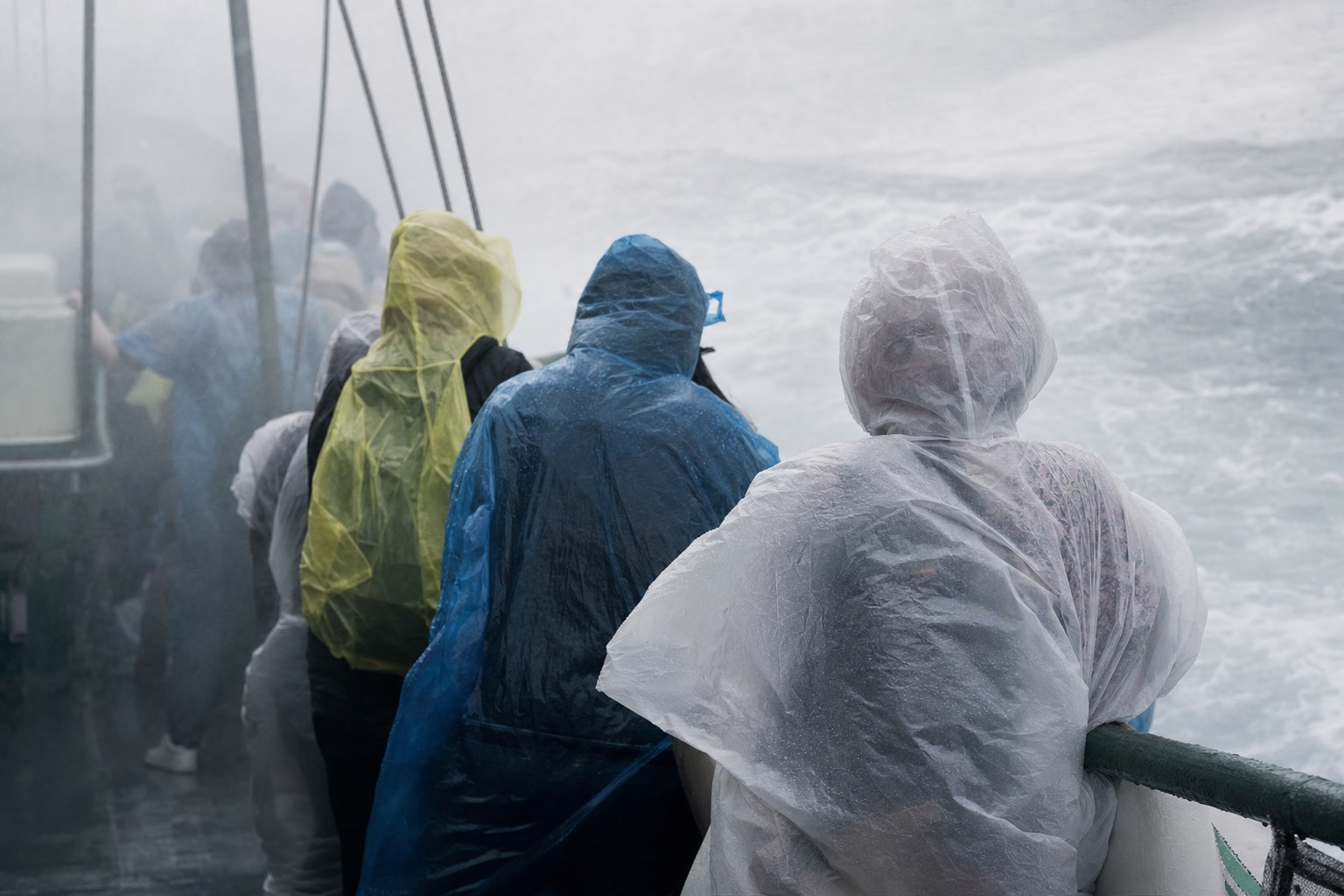
Yes. Both boats hand out a poncho, blue on the American side and red on the Canadian side, and neither keeps you dry once the boat enters the Horseshoe Falls basin. Expect wet hair, wet shoulders and wet shoes. The only genuinely dry option is the enclosed space on the Canadian vessels.
The spray at the base of Horseshoe Falls does not behave like rain. Rain falls. This arrives sideways, in sheets, from a direction that changes every few seconds, and it goes under a poncho hood with no effort at all.
Match the experience to your comfort needs first. A guided package adds land attractions but cannot guarantee a dry or quiet boat ride.
Booking choice. Maid of the Mist, Cave of the Winds and the Observation Tower in one guided American-side itinerary. Explore USA boat, Cave & hotel pickup
Do you get wet on the Niagara Falls boat tour?
Yes, reliably and thoroughly. A poncho is included on both boats and neither prevents a soaking once you are inside the Horseshoe Falls basin. Assume wet hair, wet shoulders, wet forearms and wet shoes, and treat anything you are carrying as exposed.
The confusion comes from the poncho itself. It looks like protection, so people plan around it, and then discover it is a wind-catching plastic sheet with open sides. It keeps the worst of the water off your torso for the first minute. After that it is holding water rather than shedding it.
| Body part | How wet, realistically |
|---|---|
| Hair and face | Soaked; the hood blows back constantly |
| Shoulders and upper arms | Soaked through the poncho gaps |
| Torso | Mostly dry if the poncho stays closed |
| Forearms and hands | Soaked, and cold in shoulder season |
| Trousers below the knee | Wet from spray and from deck water |
| Shoes and socks | Wet on the deck, wetter at the rail |
| Anything in an open pocket | Treat it as ruined |
Which parts of the boat are worst?
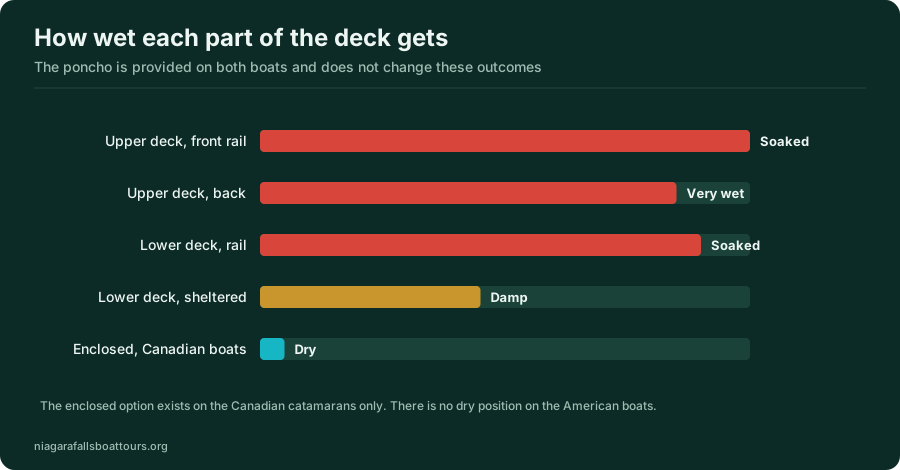
The upper deck front rail, by a wide margin. It has the best view and takes the full weight of the spray. The lower deck is more sheltered but more crowded, and the Canadian vessels have enclosed space behind glass that is genuinely dry.
There is a real choice here and it is worth making deliberately rather than by accident of where the crowd pushes you.
| Position | View | How wet | Who it suits |
|---|---|---|---|
| Upper deck, front rail | Best on the boat | Completely soaked | Anyone who came for the full experience |
| Upper deck, back | Good, over heads | Very wet | Late boarders |
| Lower deck, rail | Low, close to the water | Soaked | Photographers wanting the waterline angle |
| Lower deck, sheltered | Partial | Damp | Families with small children |
| Enclosed, Canadian boats | Through glass | Dry | Cameras, cold days, anyone who would rather watch |
The enclosed option only exists on the Canadian side, where the 700-passenger catamarans have indoor space. Niagara City Cruises describes it as part of the standard experience rather than an upgrade. On the American boats there is no meaningfully dry position.
What happens to your phone?
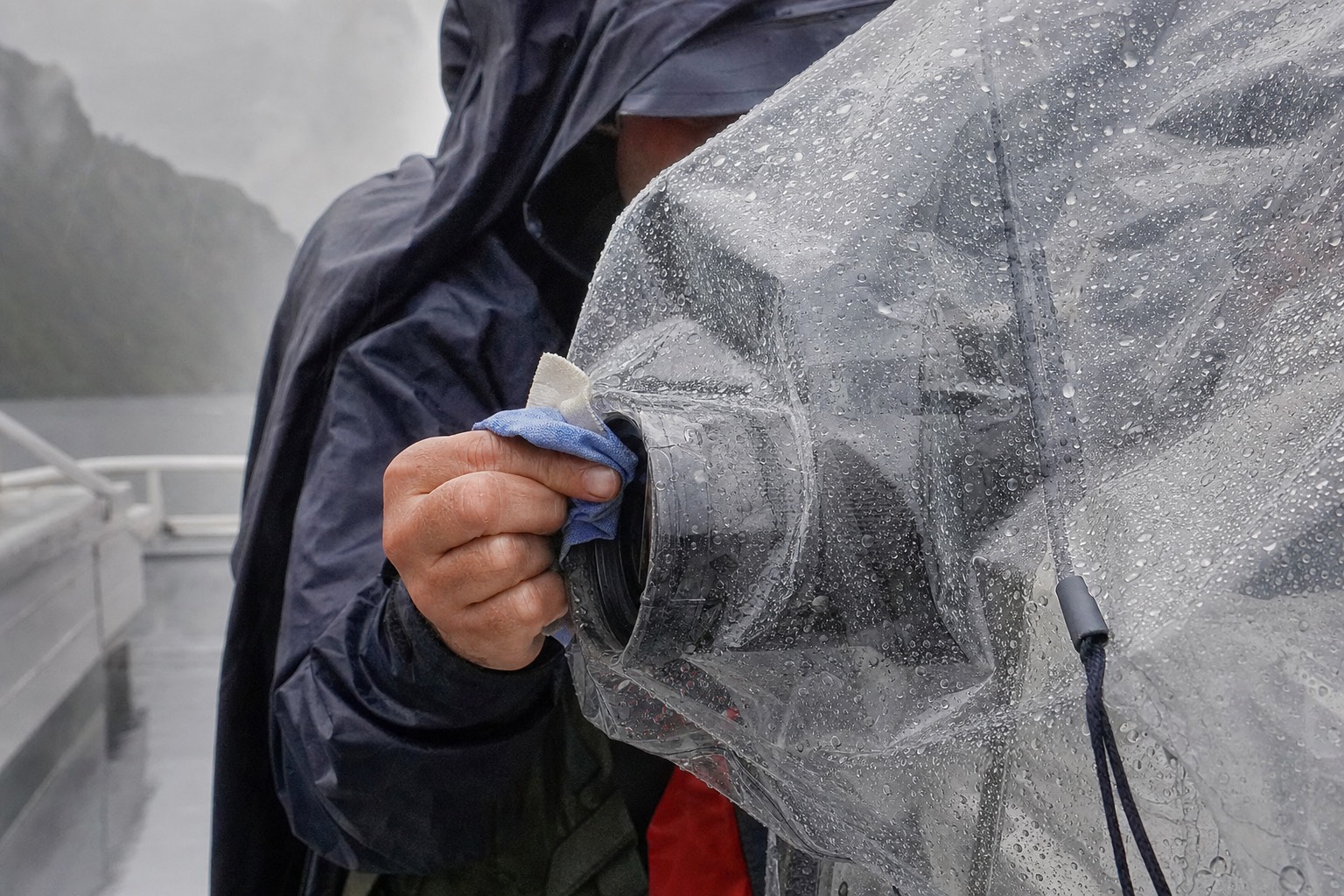
It gets rained on sideways for several minutes. A phone rated for water will survive; a phone in a hand at the rail without a pouch is being gambled with. The bigger problem is not damage but the lens, which fogs and beads and ruins every shot you take in the basin.
This is the practical failure people regret most, because the photographs are the reason the phone came out. A cheap waterproof pouch solves both problems at once: it keeps the water out and gives you a flat surface to wipe between shots.
| What you bring | What happens in the basin |
|---|---|
| Phone, bare, in hand | Works, but the lens beads and most shots are unusable |
| Phone in a sealed pouch | Works, wipeable, the reliable option |
| Phone in a coat pocket | Wet pocket, wet phone |
| Compact camera, no cover | Spray on the lens within seconds |
| DSLR or mirrorless, no rain cover | Do not, unless you are content to towel it dry |
| Glasses | Useless from the moment the spray starts |
Our what to wear and bring guide covers the full kit question, including the footwear mistake that catches people out at the landing.
Can you avoid getting wet altogether?
Only two ways. Ride the Canadian boat and stay in the enclosed space behind glass, or do not ride at all and watch from the promenade. There is no dry position on the open deck of either vessel.
The third option people try, which is standing at the back of the upper deck behind other passengers, does not work. The spray is not directional in a way that lets you hide behind someone.
If being soaked is genuinely unacceptable, consider whether the boat is the right attraction for you. Journey Behind the Falls on the Canadian side puts you behind the water in rock tunnels and keeps you largely dry, and it runs year-round. Cave of the Winds on the American side does the opposite and soaks you far harder than the boat does.
Does it depend on the weather?
Less than you would think. The spray in the basin is generated by the falls, not the sky, so a bright still day still soaks you. What weather changes is the wind, which decides how far the spray carries and therefore how much of the transit up the gorge is wet as well as the basin itself.
Rain is not a reason to skip the ride. You are getting wet regardless, the crowds thin, and the queue shortens. High winds are different, and both operators can cancel sailings for safety without notice. Our season guide covers the conditions that stop the boats entirely.
How wet is the boat compared with everything else at the falls?
The boat is the middle of the scale, not the top. Cave of the Winds' Hurricane Deck is the wettest thing at Niagara by a distance, the jet boats drench you by design, Journey Behind the Falls is mist rather than soaking, and the viewpoints keep you dry unless the wind swings the spray column your way.
Calibrating this properly changes how people dress and what they book, so here is the whole wetness ladder in one place.
| Experience | How the water arrives | What ends up wet | Drying time on a warm day |
|---|---|---|---|
| Whirlpool jet boat, open top | Deliberate wave immersion, repeatedly | Everything, to the skin, guaranteed | You change clothes; that is the design |
| Cave of the Winds, Hurricane Deck | Bridal Veil Falls landing on you from above | Everything the poncho does not seal | An hour-plus for shoes |
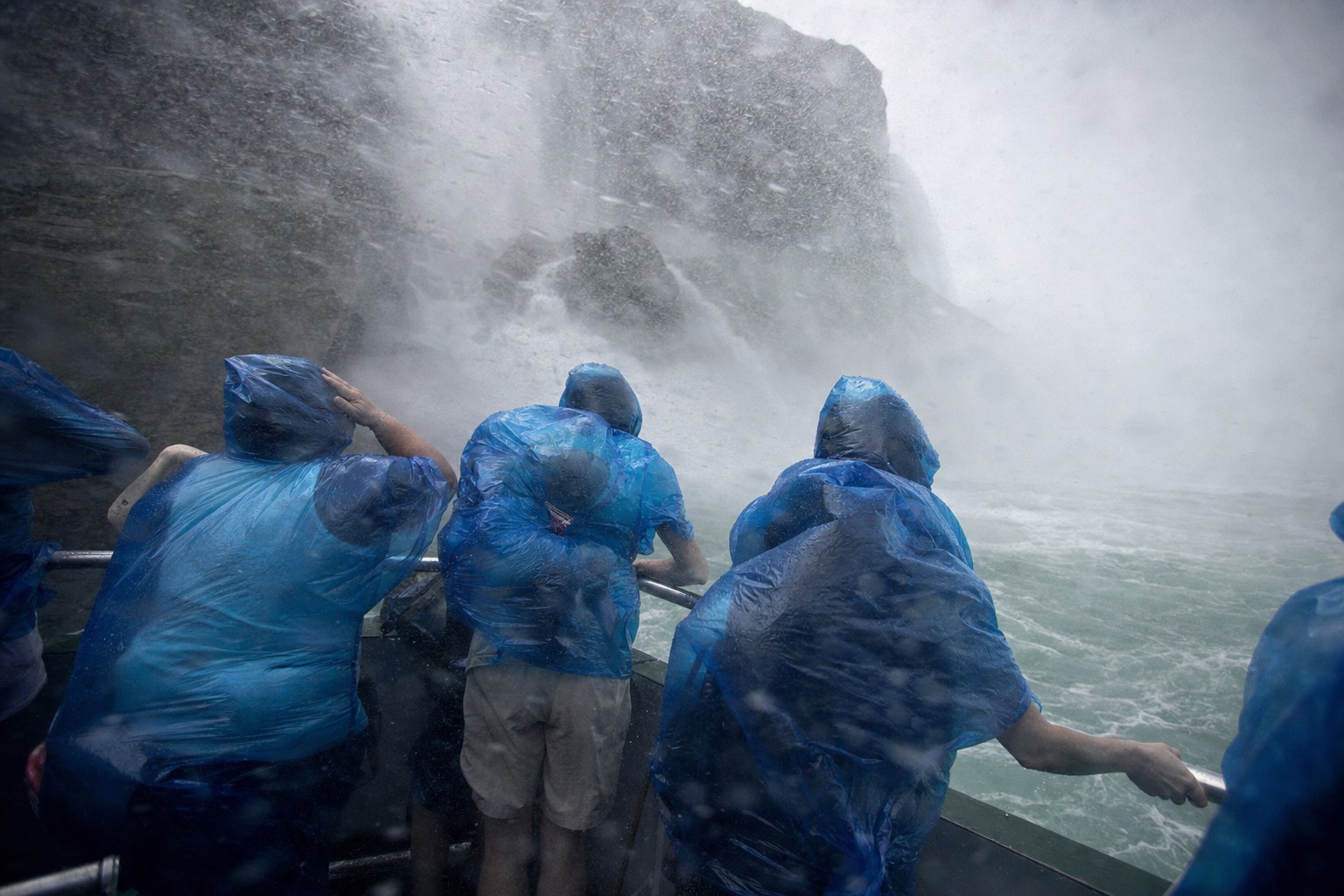
| The boat, at the rail | Sideways sheets of spray in the basin | Shoulders, hair, face, forearms, camera | 20 to 30 minutes, shoes usually fine |
| The boat, inside or behind glass | Drifting mist | A light film, nothing more | Minutes |
| Journey Behind the Falls portals | Hanging mist from the sheet | Hair and glasses | Minutes |
| The promenade and viewpoints | Only when wind carries the column over the rim | A surprise misting on gusty days | Trivial |
The rail-versus-inside distinction on the boat is the one worth knowing in advance, because it is a genuine choice rather than luck. The Canadian catamarans have enclosed deck space behind glass, and the American boat's lower deck is markedly more sheltered than the bow. Standing at the open rail through the basin is the full experience and the full soaking; two steps back and behind a windbreak cuts the water by more than half while costing surprisingly little of the view. Families split exactly this way, one adult at the rail with the older kids, one behind glass with the toddler, and it works.
What the ladder also makes clear is the sequencing trick from our worth-it guide: if you are doing the boat and Cave of the Winds on the same American-side morning, the boat first is the only sensible order, because the Hurricane Deck resets everyone to maximum wet regardless of what came before.
What gear actually survives, and what should stay in the hotel?
Phones survive with a pouch or an inside pocket, cameras survive with a rain cover and a lens cloth used constantly, and anything paper does not survive at all. The mistake is not bringing the wrong things; it is holding the right things in your hands when the basin arrives.
A short, honest gear audit from the research for this site, framed for the boat's specific kind of water, which is wind-driven mist rather than rainfall.
| Item | Verdict on the boat | The practical move |
|---|---|---|
| Modern phone | Fine if stowed for the basin minutes | A zip pouch or the pocket under the poncho; wet-screen touch is the real failure, not water damage |
| Mirrorless or DSLR camera | Usable with discipline | Rain cover or a hotel shower cap, lens cloth in a dry pocket, shoot early then stow |
| Action camera | The right tool | Chest or head mount, set it running before boarding, forget it |
| Glasses and sunglasses | You will be wiping constantly | A cord, and accept the blur in the basin |
| Paper tickets, maps, passports | The casualty list | Everything paper inside two layers; the phone ticket beats the printed one here |
| Footwear | Survives on the boat, drowns at Cave of the Winds | Trainers fine for the boat alone; sandals if pairing with the Hurricane Deck |
| A small towel | The unglamorous winner | One hand towel in a daypack upgrades the entire hour after the ride |
The camera row deserves its honest caveat: the best photographs from the ride happen in the first half, up the gorge and past the American Falls, in clean air. Inside the basin the lens is wet within seconds and everything shoots soft white. Plan the shot list that way, take the gorge and the approach seriously, then put the camera away and stand in the noise. The people filming the whole basin get four minutes of white blur; the people who stowed the phone get the four minutes.
What to wear underneath it all, month by month, lives in our packing guide, and the season's temperature swing is in the best-month guide.
What if you genuinely cannot get wet?
You still have real options, and one of them is excellent. The enclosed deck space keeps the ride while cutting most of the water, Journey Behind the Falls delivers the close-up with only hanging mist, and the viewpoints cost nothing. What does not exist is a dry version of the rail in the basin.
The reasons people need this section are practical rather than fussy: a cast that cannot be soaked, a medical device with a water rating nobody wants to test, a wheelchair user who would rather not spend the afternoon in wet clothes, a baby asleep in a carrier, or simply a February-cold day in early May when a soaking stops being fun.
| Constraint | The move | What you keep |
|---|---|---|
| Cannot soak a cast, dressing or device | Enclosed deck on the Canadian boat, or the American lower deck's sheltered side | The full ride, most of the view, a fraction of the water |
| Wheelchair, prefer to stay dry | Behind-glass position plus the accessible boarding both operators run | The basin at eye level without the drenching |
| Sleeping infant | One adult behind glass with the baby, the other at the rail | Everyone rides; nobody negotiates with a wet newborn |
| Cold-day visit | Journey Behind the Falls instead of the boat | The close-up, in a jacket, with dry shoes |
| No appetite for wet at all | The promenade, the Observation Tower, the crestline viewpoints | The spectacle, entirely on your terms, mostly free |
The honest boundary to draw: enclosed space is a genuine ride with genuinely less water, not a diet version to apologise for. The engine note, the scale, the moment the basin opens up, all of it happens on the other side of the glass too. What it softens is the physical side, the wind and the sheets of spray, which is exactly the part the constrained travellers above need softened. The one thing this page will not pretend is that any seat stays fully dry; mist is the medium the whole place is made of, and a light film of it reaches everywhere, which is also why the what-to-wear guide matters even for the behind-glass plan. For the full mobility picture, boarding mechanics included, see the accessibility guide.
How do you actually wear the poncho?
Like a tent, not a raincoat. Hood up before the basin, one hand pinching it closed at the chin, arms inside until you need them, and the hem outside the rail rather than trapped against it. Worn properly it keeps your core dry; worn like a jacket it funnels water down your collar.
The poncho is a single sheet with a hood, and the difference between the drenched-through passengers and the merely damp ones is technique rather than luck. Michael's boarding-ramp briefing, condensed:
| Move | Why |
|---|---|
| Hood up early, before the spray starts | A wet hood against dry hair defeats the purpose |
| Pinch the hood at the chin in the basin | The wind drives spray upward as much as down |
| Keep arms inside until shooting | Sleeve gaps are the main entry point |
| Let the hem hang free | Pressed against the rail it channels water onto your legs |
| Face the spray, not away | The hood seals better front-on, and the view is the point |
| Keep it for the day on the blue-poncho side | It doubles as a bench cover and a bag cover for Cave of the Winds |
The last row is the American side's quiet bonus: the blue poncho is yours to keep, and the visitors who fold it into a pocket instead of binning it at the exit have a free second poncho for the Hurricane Deck an hour later. The red Canadian poncho goes into the recycling stream at the landing, which is the better environmental answer and the worse personal-logistics one.
Getting-wet questions
Do the ponchos actually keep you dry?
No. They slow the water down for the first minute and then stop working, because the sides are open and the hood blows back in the wind off the falls. Treat the poncho as a courtesy rather than protection and dress underneath it accordingly.
Which side gets you wetter, American or Canadian?
Neither meaningfully. Both boats enter the same Horseshoe Falls basin and both get thoroughly sprayed. The only real difference is that the Canadian vessels have enclosed space where you can stay dry, and the American ones do not.
Should you bring a change of clothes?
A dry top layer is worth having, especially in May, October or early November when the spray is genuinely cold. In July and August most people dry off within half an hour and think nothing of it. Dry socks are the underrated item.
Can you take a phone on the Niagara boat?
Yes, and most people do. Bring a sealed waterproof pouch rather than relying on a water-resistant rating, mainly because the pouch gives you something to wipe. Bare lenses bead up in the basin and most photographs taken there are unusable.
Is it worth riding if you hate getting wet?
On the Canadian side, yes, because you can watch from the enclosed space behind glass. On the American side, less so, since there is no dry position. Journey Behind the Falls in Ontario is the better choice if staying dry matters and you still want to be close to the water.
What should you wear on the boat?
Quick-drying layers, closed shoes with grip because the deck is wet, and nothing you mind soaking. Leave the umbrella behind; it is unusable on deck and a hazard to the person beside you. In cool months put a warm layer under the poncho rather than trusting the poncho itself.
Choose your Niagara day
General editorial starting point; confirm dates, route and personal requirements.
USA boat, Cave & hotel pickup
Have a travel date in mind? Check this itinerary before arranging separate admissions. Maid of the Mist, Cave of the Winds and the Observation Tower in one guided American-side itinerary.
About 4 hours, plus pickup up to an hour before. Pickup in Niagara Falls, NY, not Buffalo or NYC. English; shared tour. Boat and Cave operations are seasonal; winter substitutes differ. Food is extra. Confirm access needs with the operator.
Choose a date to see Viator scheduled departures. Final availability and price are confirmed on Viator.
Choose only the details that matter. Unanswered fields keep this general guidance; a choice can rule out a package.
| USA boat, Cave & hotel pickup | Maid of the Mist, Cave of the Winds and the Observation Tower in one guided American-side itinerary. About 4 hours, plus pickup up to an hour before. Pickup in Niagara Falls, NY, not Buffalo or NYC. English; shared tour. Boat and Cave operations are seasonal; winter substitutes differ. Food is extra. Confirm access needs with the operator. |
|---|---|
| Canadian walking tour: boat, Journey & Skylon | Journey Behind the Falls, Skylon Tower and a seasonal Niagara City Cruises ride in one walking itinerary. About 3 hours 15 minutes plus check-in. Choose the Niagara Falls, Canada walking option. Meet inside Skylon Tower, 5200 Robinson Street, at the See Sight check-in. English. Guided portion ends at boat boarding; no return transfer. Winter boat replacement is Niagara Takes Flight, which excludes infants and children under 100 cm. Confirm exact seasonal itinerary and access needs. |
| Both sides with boat, Cave & Skylon | American-side boat and Cave stops plus Skylon Tower views in Canada. About 6 hours, plus pickup and border delays; reserve a full day. Niagara Falls ON/NY hotel pickup. English; shared tour. Appropriate entry documents for both countries required. Reconfirm with Over the Falls at least 24 hours ahead. Vehicles cannot accommodate occupied wheelchairs; assisted transfer and collapsible chairs need advance arrangement. Seasonal substitutions; food extra. |
Compare your own group totals
Use the same currency and the same party. Include admissions, transport, parking and taxes in the DIY total. Quotes are your inputs, not prices supplied here.
Enter both totals to compare the cost of the guided itinerary with your independent plan.